Chinese home style · Buns & Pancakes
Rose Mantou (玫瑰花馒头)
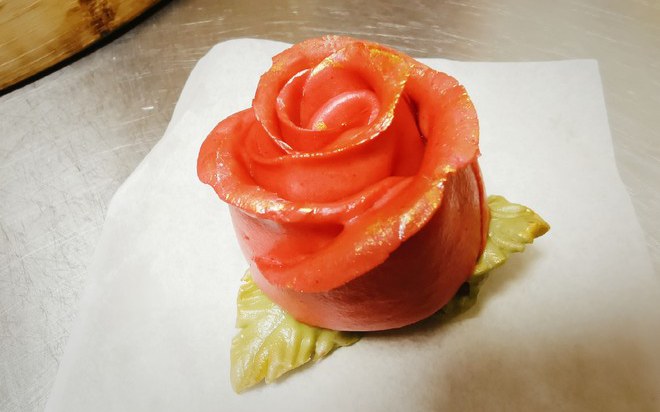
Rose-shaped steamed buns tinted with red yeast rice: hand-rolled petals, green leaves and optional gold dust — an edible bouquet for Valentine's or Mother's Day.
Instructions
-
 Make the dough: stir the yeast and sugar into the lukewarm milk (about 35°C/95°F — feels warm, never hot), add the flour and oil, and knead 8–10 minutes until smooth and springy.
-
 Cut off 250 g of dough and knead the red yeast rice powder into it — 1 tsp gives deep red roses, ¼ tsp gives pink. Knead 2–3 minutes until no streaks remain; the dough should be one even shade.
-
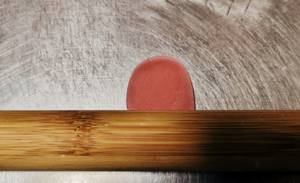 Knead the spinach or matcha powder into the remaining dough for the leaves. Rest both colored doughs, covered, in the fridge for 10 minutes — this relaxes the gluten so the discs roll out without springing back.
-
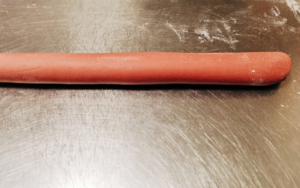
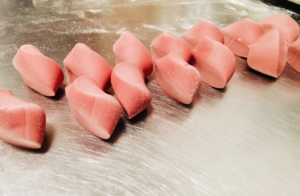
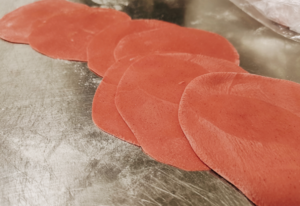 Knead the red dough 1 minute to deflate it, roll it into a 3 cm thick log and cut into 8 equal pieces (about 30 g each). Keep every piece covered while you work.
-
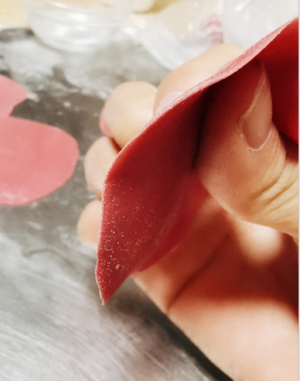 Flatten one piece with the heel of your palm and roll it into an 8–9 cm disc, thick in the middle and thin at the edges, like a dumpling wrapper — under 1 mm at the rim.
-
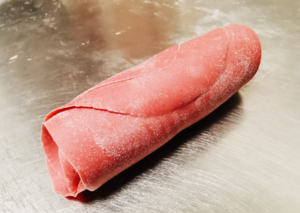 Overlap 5–6 discs into a strip: press the first three discs together tightly, then set each following disc a little farther back, with the widest gap before the last one. Real roses overlap most near the heart.
-
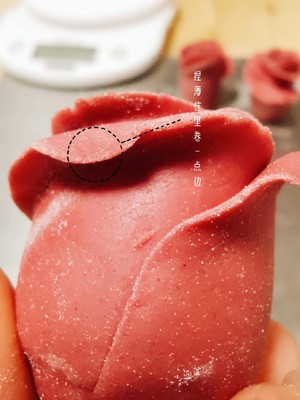 Roll the strip up from the far end into a snug cylinder, brushing the last petal's edge with a little milk or water so it seals shut.
-
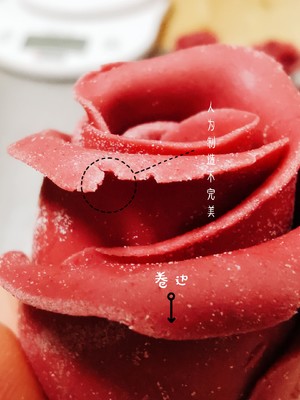 Pinch around the middle of the roll with your thumbs and ring fingers, then slice through the waist with a knife — one roll yields two rose buds. Fan the petals open and curl their outer edges outward with your fingertips.
-
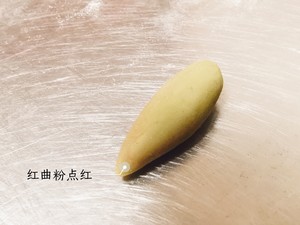 Make the leaves: roll 3 green teardrops (7–8 g each) per rose into pointed leaf shapes, press a center vein with the back of a paring knife, and dab a trace of red yeast powder on the tips so they look naturally aged.
-
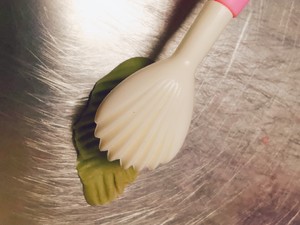 Attach 3 leaves around the base of each rose with a dab of milk, pressing firmly so the seams disappear.
-
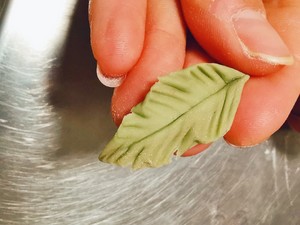 Optional gold dust: dip a fine brush in milk, then barely touch it to the gold luster dust and paint only the curled petal edges — sparingly, a few flecks per petal.
-
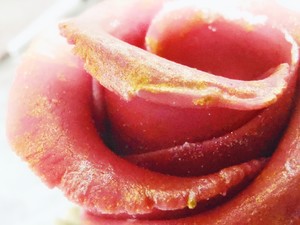 Set the roses on paper liners in a steamer, cover, and proof 20–30 minutes, until they look visibly puffed and feel noticeably lighter.
-
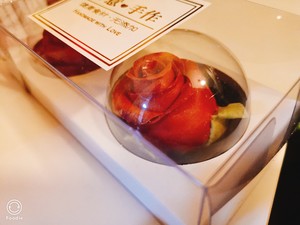 Steam over medium heat from cold water. Start timing when the water boils: 12 minutes for roses this size. Turn off the heat and wait 5 minutes with the lid on before opening, so the petals don't wrinkle.
Why this recipe works
Three small decisions separate a rose that looks like a cinnamon roll from one that makes people hesitate before biting.
1. The petal overlap gradient. Five or six identically cut discs are stacked with decreasing overlap — nearly on top of each other at the start, drifting apart toward the end. When the strip rolls up, that gradient reproduces how a real rose constructs itself: crowded petals at the heart, loose ones at the rim. Get the spacing right and even a first-timer's rose reads as a flower.
2. Center-thick, edge-thin discs. Rolling the discs like dumpling wrappers does two jobs at once. The thick hub gives the rolled bud enough body to stand up, while the paper-thin edges steam into soft, slightly translucent curves instead of doughy flaps. Under a millimeter at the rim is the target — if you can almost see light through the edge, it is right.
3. Red yeast rice, not dye. Red yeast rice powder (红曲粉) colors the dough a dusty, believable red that survives steaming with a gentle fade, and it lets you dial pink-to-crimson with the same jar. Brushing a trace of it onto the leaf tips is a florist's trick: no real leaf is one uniform color, and the aging touch sells the whole arrangement.
About the dish
Shaping steamed dough into flowers belongs to the huamo (花馍) tradition of northern China, where flower-shaped steamed breads have been made for weddings, festivals and gifts for centuries — Shandong and Shanxi are especially famous for them. A rose is the modern, minimalist branch of that family tree: no mold, no multi-color lamination, just discs, a roll and a knife cut.
This version is built for gifting — the source recipe frames it as a Mother's Day and Valentine's Day present, and that is exactly its strength. A dozen roses, leaves attached, dusted with a fleck of gold and boxed like real flowers, cost a few dollars and say something a florist's box cannot. The roses keep their shape for days and re-steam beautifully, which is more than can be said for the fresh-cut kind.
What to serve with it
Present them in a shallow box lined with parchment, the way a florist packs peonies — a dozen boxed roses with a short note turns a plate of buns into a gift. At the table they are dessert enough on their own with hot tea, though a plate of egg fried rice turns the arrangement into lunch. For more shaped and classic steamed buns to build a gift basket around, browse the buns page. A box of rose shaped steamed buns travels well too — steam in the morning, box them once cool, and hand them over the same day.
Pro tips
- Weigh every piece of dough. Petals only stack evenly when the discs are the same size — eyeball it and roses three and four onward turn out lopsided.
- Roll the petal discs thinner than feels safe. Thick, even discs steam into doughy paddles; center-thick, edge-thin discs puff into curved petals.
- The overlap spacing is the entire illusion: nearly stacked at the flower heart, progressively looser outward. Look at a real rose once and you'll never forget the rhythm.
- Colored doughs show dry skin and cracks much faster than plain white. Keep a damp towel over everything you are not actively shaping.
- Red yeast rice color deepens slightly as the dough rests and fades a shade in the steam — mix the color one shade darker than the finish you want on the table.
- If you are new to luster dust, skip the wet-painting method and tap dry powder off a brush over the proofed roses instead — it lands as a natural starry scatter.
Storage & leftovers
- Refrigerate cooled roses in a sealed container for up to 3 days; re-steam 5 minutes to bring back the softness.
- Freeze up to 1 month in a freezer bag with the air pressed out. Re-steam straight from frozen for about 12 minutes.
- Avoid the microwave — it toughens the thin petals first. If you must, cover with a damp paper towel and use 20-second bursts.
Frequently asked questions
What is red yeast rice powder and where do I find it?
It is rice fermented with a mold that produces a natural deep red pigment — a traditional Chinese colorant with a faint, pleasant aroma. Look for it in Asian grocery stores or online as red yeast rice powder (monascus). A few drops of red gel coloring also work, though the shade is flatter.
Can I skip the gold dust and leaves?
Yes. A plain red rose is already lovely; the leaves add realism and the gold dust adds occasion. If you skip the leaves, knead a full batch of red dough instead and you'll get about 11 roses.
My petal edges cracked while rolling. What went wrong?
The dough was too dry or too cold. Knead in a few extra drops of water until the dough is soft but not sticky, and let it re-relax 5 minutes before rolling. Also brush off excess dusting flour — it dries the surface.
How do I stop the roses from slumping in the steamer?
Three checks: proof only until puffed and light (not doubled), keep 3 cm between roses, and use a bamboo steamer or a lid wrapped in a cloth so condensation does not drip onto the petals.
Can I make them ahead?
Shape the roses, place them on a tray, cover tightly with plastic, and refrigerate overnight — then proof 30 minutes and steam. Steamed roses also freeze well: cool completely, freeze in a bag up to 1 month, and re-steam 12 minutes from frozen.
How do I get pink roses instead of red?
Use ¼ tsp red yeast rice powder instead of 1 tsp for the full batch. For a two-tone bouquet, divide the red dough and color two portions with different amounts — the pale pink ones read as garden roses.
Is the gold luster dust safe to eat?
Only if the label says edible or food grade — food-grade luster dust is fine in the small quantities used here, just flecks on the petal edges. Craft glitter is not edible and should never go near the buns; when in doubt, skip it or use the dry-brush scatter on top of fully cooled roses.