Chinese home style · Buns & Pancakes
Unicorn Mantou (独角兽馒头)
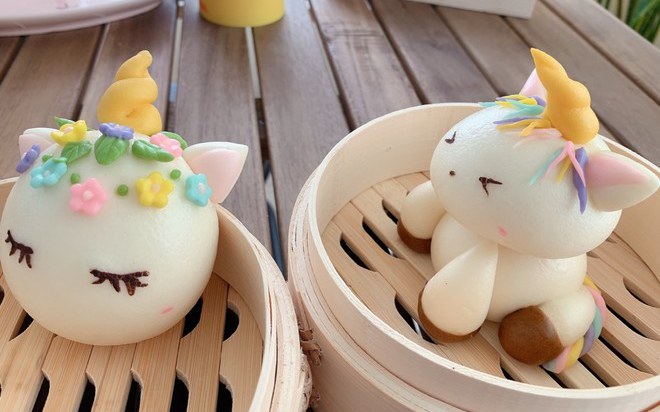
Pastel unicorn steamed buns with a golden horn, tiny ears and cocoa-drawn eyes — an easy milk dough shaped into one beginner head and one full-body unicorn.
Instructions
-
 Make the dough: stir the cold milk, yeast and sugar together, then add the flour and oil. Mix to a shaggy mass, then knead with a stand mixer on medium for 6–8 minutes until smooth and slightly tacky (by hand, 12 minutes). The cold milk keeps the dough slow-rising while you work. Shortcut: instead of kneading, flatten the dough and run it through a pasta roller on its widest setting, fold, and repeat 6–8 times — lamination develops the gluten just like kneading, without warming the dough.
-
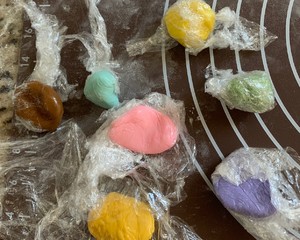
 Divide and color: keep about 110 g of dough white for the heads and bodies. Pinch off small pieces and tint them gold (the horns), brown (the hooves), pink (ears, petals, blush) and green (the leaf), kneading each drop of color in fully before adding more — color goes in a little at a time and never all at once. Keep every piece wrapped while you work.
-
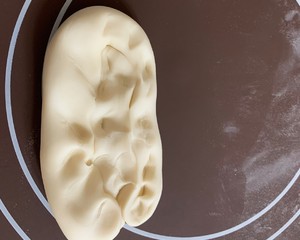
 Shape the unicorn head (design 1): take 50 g of white dough and degas it — press it flat with your palm heel, push it away across the counter, fold it into thirds, and repeat 2–3 times until the surface is tight and smooth. Pinch the seam closed, then roll it into a tall, glossy ball on the counter, using a single drop of milk or water under it to grip. Set it on a parchment square.
-
 Make the horn: roll 2 g of gold dough into a rope that tapers at both ends, fold it in half, and twist the two legs around each other like a two-strand braid. Dab water or milk at the tip to weld it, squeeze gently, and glue the horn upright on the head, slightly forward.
-
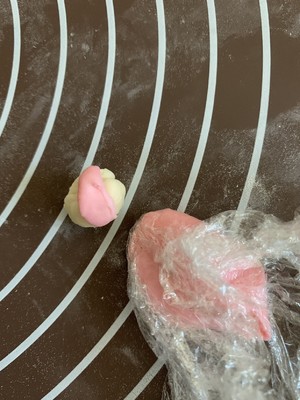
 Make the ears: flatten 2 g of white dough, lay 1 g of pink dough on top, flatten them together, and cut the stack in half to make two pink-tipped ears. Glue them on the head with milk, angled outward.
-
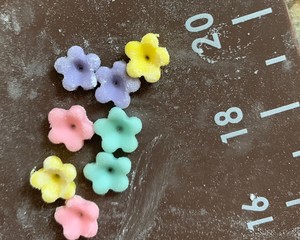
 Add the flowers and leaf: roll leftover dough 2 mm thin (the pasta roller on settings 2–3 gives perfectly even sheets), cut small petals and a leaf, score the leaf's veins with a knife, and glue the petals around the base of the horn and ear, leaving a visible gap for the leaf.
-
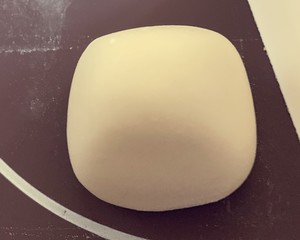
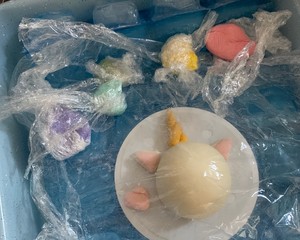 Shape the full-body unicorn (design 2): take 28 g of white dough, degas and roll it smooth, then square it into a body that is narrow on top and wider at the bottom. Make 4 legs from 2 g teardrops of white dough with 1 g brown hooves glued at the tips, and attach them with milk — two in front, two behind, slightly staggered so the pony looks mid-step.
-
 Give it a mane and tail: roll thin ropes of pink (or the same color you used for the tail accent), twist pairs together, and glue a short twisted rope at the rear as the tail and a wavy rope down the neck as the mane.
-
 Add the second head: take 35 g of white dough — deliberately larger than the 28 g body, since a big head on a small body is what makes it cute — degas, round it, and glue it on top of the body. Add a second gold horn and ears as before.
-
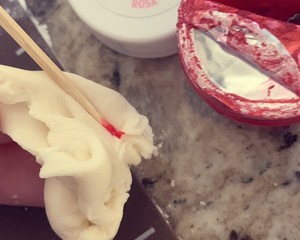
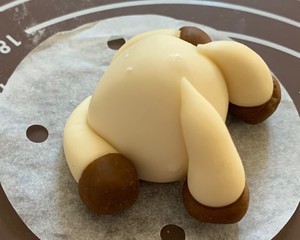 Draw the faces: once both unicorns are assembled, dip a toothpick or fine brush into the cocoa-and-water mixture and draw closed sleepy eyes, tiny nostrils and a small mouth. Chill both buns, uncovered and loosely tented with plastic, while you set up the proofing.
-
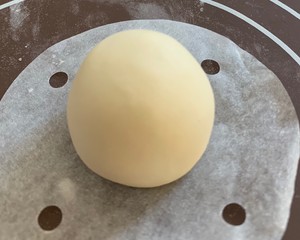 Proof: place the buns in an oven with a bowl of steaming-hot water (around 35–40°C / 95–104°F and 65% humidity) until they grow to 1.5 times their size and a dough-dusted fingertip leaves a dent that creeps back slowly — the surface should feel taut like an inflated balloon, about 40–60 minutes.
-
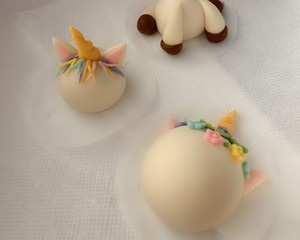 Steam from cold water over medium heat for 10 minutes. Turn off the heat and rest 4 minutes with the lid on to avoid collapse, then lift the lid away at an angle so no drips land on the unicorns. Cool on a rack, then paint two pink blush circles under the eyes with the red yeast-and-milk paint.
Why this recipe works
Unicorn mantou borrow their cuteness from proportion, not artistry — a big round head, a small body, tiny ears — and the whole build is balls, ropes and pressed sheets. Three details keep it from going sideways.
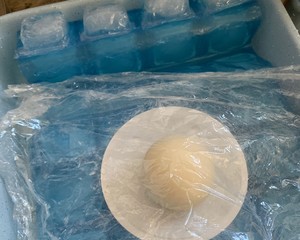
1. Cold dough buys you time. The original recipe mixes with cold milk and, in summer, parks shaped pieces on ice packs. Warm dough proofs while you sculpt, so part five of the unicorn has already risen while part one is still flat-faced — and proofed dough is slack, sticky and impossible to keep sharp. Cold dough stays firm through the entire build, which is why a first-timer's unicorn can come out as crisp as a practiced one's.
2. Lamination instead of kneading. The “no hand-kneading” trick — folding the dough through a pasta roller 6–8 times — develops gluten exactly like kneading does, with two bonuses: the dough never warms under your palms, and the final passes turn it into perfectly even 2 mm sheets for petals and leaves. It is the same principle as croissant lamination, applied to a steamed bun.
3. Weld with milk, color with restraint. A thin film of milk fuses every applied part into one seamless bun as it proofs and steams. And color goes in a drop at a time — gel pigment is far stronger than it looks, and steaming deepens whatever you mixed. Pastel comes from patience, not from pale intentions. No molds are involved — this is hand-shaped cartoon mantou.
About the dish
Cartoon mantou are a distinctly social-media-era branch of the ancient steamed bun family: home bakers compete in gentleness, posting progressively rounder animals from their steamers, and the unicorn — imported from Western birthday-cake culture — became one of the genre's signature designs. This version circulates as a “no hand-kneading” recipe, written for bakers with a stand mixer or a pasta roller and a low tolerance for wrist ache, and it is really two projects in one: a poseable unicorn head for absolute beginners, and a full standing unicorn for the second attempt. The face is drawn with a cocoa-powder pen, the blush is red yeast rice in milk — every bit of color stays edible and homemade, which is the quiet rule of the whole cartoon-mantou scene.
What to serve with it
These are birthday-table ammunition: pair them with a pitcher of warm soy milk and a small dish of red bean paste for dipping, and let the birthday child decide which unicorn is too cute to eat. For a party table, they sit happily beside fruit and a plain basket of milk buns — the unicorn is the centerpiece nobody wants to touch, so steam extras. Leftovers keep two days refrigerated and re-steam for five minutes; they also freeze well, wrapped tightly, for up to a month.
Pro tips
- Weigh every part: the source recipe's magic numbers are 50 g for the head version, and for the body version 28 g body, 35 g head, 2 g legs, 1 g hooves. A head bigger than the body is the proportion that reads cute.
- Keep a saucer with a few drops of milk beside you — every part goes on with a brush of milk, pressed for a second. Parts glued dry lift off in the steam.
- Cold dough is slow dough, and that is the point: the cold milk and cold counter buy you 40–60 leisurely minutes of shaping before anything rises. On hot days, rest the dough pieces on a covered tray over an ice pack.
- Gel coloring beats liquid coloring here — liquid adds water and makes sticky, slumping parts. Knead color in a drop at a time; undoing a too-dark piece is impossible.
- The pasta-roller shortcut is worth it even if you own no other use for the machine: 6–8 laminated folds give a smoother, more even dough than most wrists can, and colored dough stays cool instead of warming under your hands.
- Draw the face after steaming if you want the boldest lines (cocoa darkens and can blur in steam); drawing before steaming, as this recipe does, gives softer, baked-in features. Both are correct — pick your style.
Storage & leftovers
- Once completely cool, seal airtight: 3 days refrigerated or 1 month frozen.
- Resteam refrigerated buns 3 minutes, frozen 5 minutes — the colors and glued parts survive resteaming perfectly.
- Do not refrigerate with the cocoa-drawn faces touching plastic; the drawing smears. Store in a rigid container, upright, with headroom.
Frequently asked questions
Do I really need a pasta roller?
No — it is the original recipe's no-hand-kneading trick, but 8–12 minutes of proper kneading produces the same dough. The roller's advantages are speed, cool dough and perfectly even sheets for the flower petals.
Can I use natural colorings instead of gel colors?
Yes: red yeast rice powder for pink and turmeric diluted in milk for gold both work — use less than you think, since steaming deepens natural colors. Cocoa powder already handles the brown hooves.
Why did my unicorn slump and lose its shape?
Over-proofing is the usual culprit — these buns should reach only 1.5x, and soft, warm dough slumps before it ever reaches the steamer. Work with cold dough and keep the shapes compact.
Can I make more unicorns at once?
Yes — the dough scales straight up: for 6 unicorns use 450 g flour, 240 g milk, 1½ tsp yeast, 3 Tbsp sugar and 2¼ tsp oil. Parts scale with them (about 45 g of head dough each).
How far ahead can I shape them?
Shape, place on parchment, then cover and refrigerate up to 8 hours; they rise very slowly cold. Let them come back to room temperature and finish proofing before steaming.
My horn looks lumpy — how do I get a clean twist?
Roll the gold rope thinner than feels right (it puffs in the steamer), taper both ends, and keep even tension as you twist. Lumpy ropes usually mean the dough was too warm — chill it for 5 minutes and try again.
Can I freeze unicorn mantou before steaming?
Yes — freeze the shaped raw buns on a tray until solid, bag them, and steam straight from frozen with a couple of extra minutes; the design holds well. Steamed buns also freeze once cooked (up to a month) — resteam to bring back the softness instead of microwaving.
Do I need special molds to make cartoon mantou?
No — every part of this unicorn is shaped by hand from balls, ropes and cones, then welded on with a brush of milk. Molds are a shortcut, not a requirement; a small knife and patience cover the ears, horn and petals.