Cantonese · Dumplings & Dim Sum
Easy Rice Noodle Rolls (肠粉)
A fail-proof three-flour batter and an ordinary 8-inch pan: glossy, silky rice noodle rolls with sausage and scallion, no special equipment needed.
Instructions
-
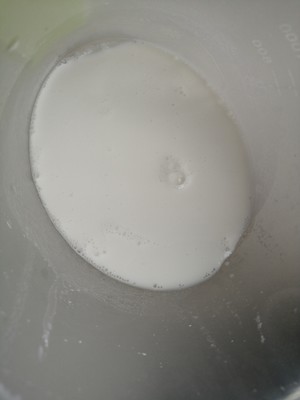
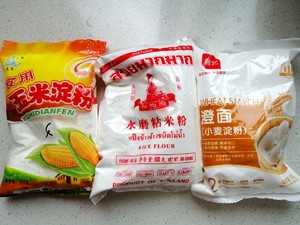 Make the batter: whisk the rice flour, wheat starch and cornstarch together in a bowl. Add the water in a thin stream while whisking — never all at once — until the batter is perfectly smooth. Stir in the 2 tsp oil, then rest the batter 10 minutes.
-
 While it rests, prep the filling: dice the sausage small, slice the scallions, and tear the lettuce if using. Put the kettle on and bring a wok or wide pot of water to a hard boil with a steaming rack inside.
-
 Make the sauce: heat 1 tsp oil in a small saucepan over medium heat, add the garlic and shiitake and cook 1 minute until fragrant. Take the pan off the heat, add the soy sauce, oyster sauce and sugar and let them bloom in the residual heat, then return it to the flame with the cornstarch-water and simmer until glossy and lightly thickened, about 1 minute. Keep warm.
-
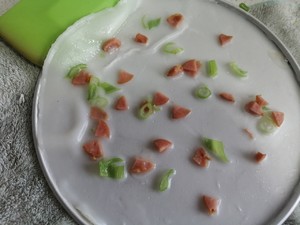 Brush an 8-inch round metal pan (a cake pan or pizza pan) with a thin film of oil. Stir the batter — the starches sink fast — then ladle in ⅓ cup (80 ml) and tilt until the whole base is covered in a thin, even layer.
-
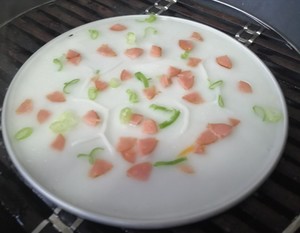
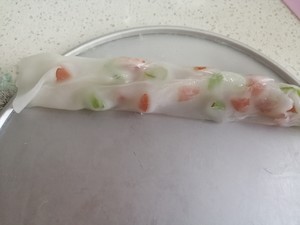 Scatter a pinch of sausage dice and scallions over the wet batter — or lay on lettuce instead. Keep it to a single sparse layer; more filling makes the roll thick and hard to seal.
-
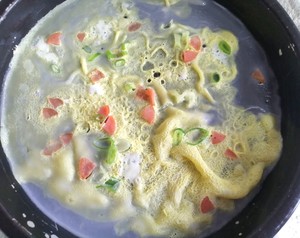 Set the pan on the rack, cover, and steam over high heat for about 2 minutes. You will see the sheet puff up into a big dome of bubbles — that is your signal. When the dome settles back, leaving gentle wrinkles, the sheet is done.
-
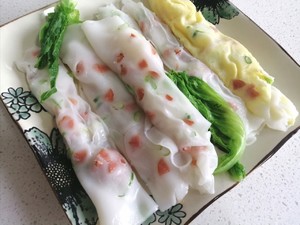 While the first steams, prep the second pan the same way — oil, batter, filling. Two pans mean one steams while you load the other, and the batch finishes twice as fast.
-
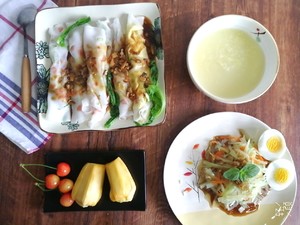 Lift the hot pan out with oven mitts (set it on a dry towel — water collects underneath). Lift a corner of the sheet with a silicone spatula, then push the spatula forward so the sheet peels and rolls itself up. Metal pans release cleanly; ceramic ones fight back.
-
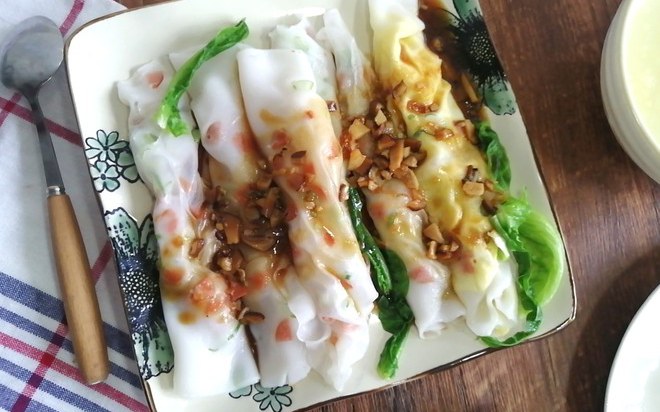
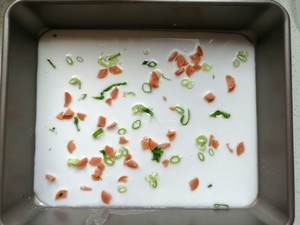 Repeat with the remaining batter — stir before every ladle, re-brush the pan — until you have 6 rolls. Stack them on a plate, spoon the warm sauce over, and eat immediately while they are soft and slippery.
Why this recipe works
Most cheung fun failures are formula failures, so this recipe starts from a tested ratio and never leaves it.
The 1:2 rule. Three powders — rice flour for body, wheat starch for stretch, cornstarch for tenderness — totaling 150 g, matched to exactly 300 g of water. The author of the original tested a drier blend and documented the failure: a chalky sheet that cracked instead of blistering and tore on scraping. Water content is what lets the starches gelatinize fully in two minutes of steam. Once you accept the ratio, the recipe stops being luck and becomes a procedure.
An ordinary 8-inch pan. You do not need a cheung fun steamer or a rectangular tray. A thin ⅓-cup layer in an 8-inch metal pan steams through just as fast and releases just as cleanly — the only real requirement is bare metal, which the cooled sheet lets go of, unlike ceramic which grips it. Two pans turn the recipe into a two-beat rhythm: steam one, load the other — cheung fun without a steamer, in the dedicated-machine sense.
The blister as a timer. Instead of watching the clock, watch the sheet: it puffs into a large domed blister, the blister settles, and wrinkles remain. That is the starch fully gelatinized — pull it then. This cue corrects itself for your pan, your burner, your batter depth, which is why it is more reliable than any minute count.
About the dish
Cheung fun — steamed rice noodle rolls — is a Cantonese breakfast classic, and the version most home cooks outside Guangdong learn first is exactly this one: a three-flour batter steamed in a simple round pan. The author of the original is a home cook from Shandong who reverse-engineered it through trial and error, including the instructive failure of a drier batter — proof that the dish belongs to anyone willing to weigh their flour.
Traditional shops roll cheung fun around shrimp, beef or char siu; the home version here uses diced Chinese sausage and scallions, which smoke gently in the steam and perfume the whole batch. The sausage-and-scallion filling is not a compromise so much as the home style — the dish was always a vehicle for whatever the kitchen had that morning.
What to serve with it
Six rolls feed two generously or three lightly as breakfast or a snack lunch. Serve with hot tea and, if you want a fuller table, a pot of congee or steamed rice. A spoonful of chili crisp or the doubanjiang-spiked sauce mentioned in the tips wakes the dish up; something cool and pickled from our cold dishes makes it a meal. And pour the warm mushroom-soy cheung fun sauce over the stacked rolls rather than dipping — that is how the stalls do it.
Pro tips
- The ratio is the recipe: flours to water is exactly 1:2 by weight (150 g flour to 300 g water). The author tested a drier 1:2.3 blend and it cracked, stayed chalky and tore on scraping — do not reduce the water.
- Metal pans only if you can manage it. The author's ceramic attempts steamed fine but released badly; a bare metal cake pan or pizza pan is the whole trick.
- Blister up, blister down = done. This is the single most useful doneness cue in cheung fun making, and it works on any pan and any heat source.
- Whisk the water in gradually — dumping it all in at once leaves dry clumps at the bottom that survive into the steamed sheet as hard specks.
- Spice option: stir a teaspoon of chili bean paste (doubanjiang) into the finished sauce for a fiery version.
Storage & leftovers
- Extra batter keeps in a sealed container in the fridge for up to 24 hours; whisk from the bottom until smooth before steaming.
- Leftover rolls keep 2 days refrigerated in a sealed container; re-steam 2-3 minutes to restore the softness.
- The sauce keeps in a jar in the fridge for up to 5 days and is great on plain noodles.
- Freezing is not recommended — rice sheets turn hard and chalky when thawed.
Frequently asked questions
Can I skip the wheat starch?
Yes — replace it with the same weight of tapioca starch. The rolls come out slightly chewier and a little less glassy. Cornstarch alone will not work; the sheet turns brittle.
Why did my sheets crack and tear?
Almost always too little water in the batter. This recipe is tested at a strict 1:2 flour-to-water ratio; a drier mix steams into a chalky sheet that cracks. Re-measure, don't eyeball.
I don't have an 8-inch pan. What else works?
Any flat, round or square metal pan that fits your steamer — a pizza pan, a layer-cake pan, a shallow cake tin. Aim for roughly 8-9 inches so ⅓ cup of batter still makes a thin layer.
Can I use different fillings?
That's the fun of it: a spoonful of beaten egg, raw small shrimp, seasoned ground pork, or leftover char siu all steam in the same 2 minutes. Keep whatever you add flat and thin.
Do I really need to rest the batter 10 minutes?
It takes the edge off: resting fully hydrates the starches, so the sheet steams up tender instead of slightly chalky. If you're rushed, even 5 minutes helps.
Can I make this for one person?
Halve everything, or mix the full batter and refrigerate it for up to 24 hours — re-whisk thoroughly before steaming, since the starches settle hard.
I don't own a steamer. Can I still make these?
Yes — the setup here is already the workaround: any wide pot with a lid and a steaming rack (or a heatproof plate resting on three balls of foil) holds the 8-inch pan above an inch of boiling water. That is all a cheung fun steamer is; nothing dedicated to buy.